
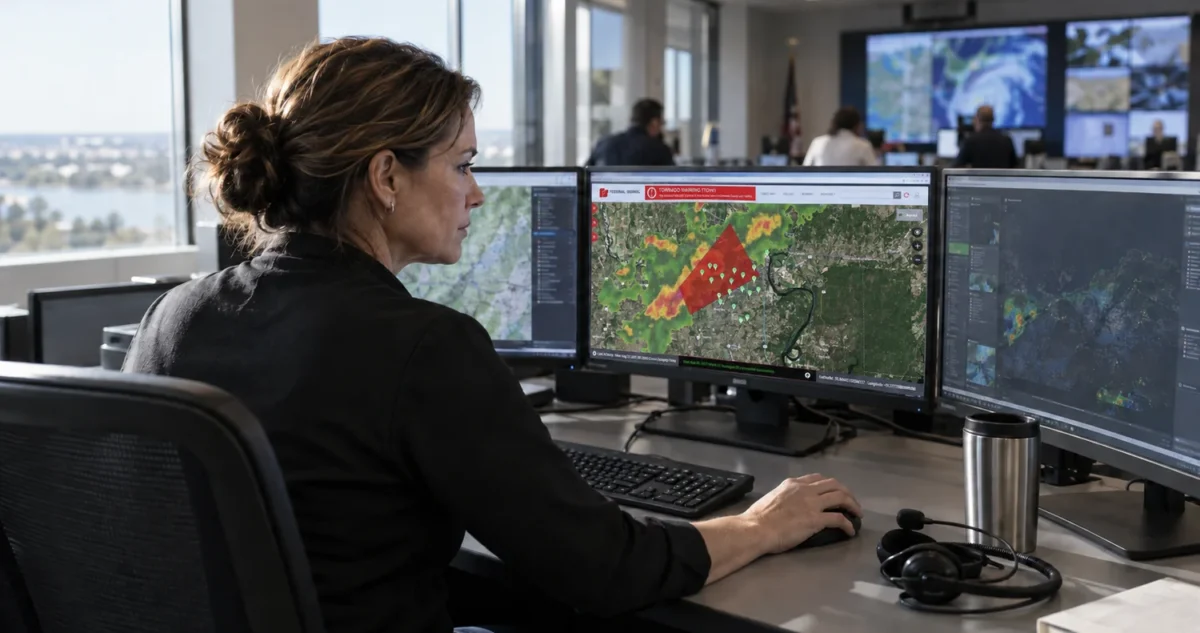
Six things decide whether emergency notification software fits a public safety team. The one buyers miss most often is hardware control. Software that only reaches phones cannot warn people standing outside. A platform also has to drive the sirens and speakers you already own.
Sizing up platforms for a city, county, campus, or plant?
OmniWarn consultations are offered free of charge.
What does emergency notification software do?
The software is the control layer of a warning system. It decides what goes off, where, and who may send. Most platforms began life as message senders. They reach people by text, email, phone call, app push, and desktop alert. That covers anyone indoors, signed up, and holding a device.
Public safety work is broader than that. Picture a tornado warning at four on a Saturday. Many people in the warned area are at a ball field, on a lake, or outside at work. They are not checking email. So the software has to reach outdoor sirens and indoor speakers too. It must do that as it reaches phones. Our emergency notification software platform covers both halves. It sends the messages and it drives the gear in the field.
Is emergency notification software the same as a mass notification system?
The two terms get mixed up, but they cover different ground. The software is the app itself. A mass notification system is the whole assembly. That means the software, the sirens, the speakers, the sensors, and the radio paths that link them.
The split matters during buying. A team that buys software alone still needs something to sound. A team that buys sirens alone still needs a solid way to set them off. Our guide to outdoor warning sirens versus mass notification systems shows where each piece fits.
Vendors split along the same line. Some sell the app and also tie into whatever hardware you have. Others sell hardware and add basic control. Fewer firms design, install, and service the whole thing. Complete mass notification solutions need both, because a message nobody hears is not a warning.
Which features should public safety teams check first?
Start with the six that decide how a platform holds up on the worst day of the year. Feature lists run long. So it helps to rank them by what fails first in a real emergency.
| What to check | What to look for | Why it decides the outcome |
|---|---|---|
| Multi channel delivery | Text, voice, email, app push, and desktop alerts, plus outdoor warning sirens and indoor warning systems | Every single channel misses somebody. Layers cover the gaps. |
| Map based targeting | Zones you can draw on a map, so only the affected area hears the alert | Over alerting trains people to ignore the next alert. |
| Automatic activation | Triggers from National Weather Service warnings and from your own sensors | Removes the delay between a warning and a human reaching a console. |
| Hardware control | Control of the sirens you already own, whatever the brand or the age | Software that only reaches phones leaves outdoor areas silent. |
| Backup signal paths | Radio, fiber, wireless IP, satellite, and multi carrier cell service | Storms take down the single path first. |
| Offline activation | Physical hardware that fires the sirens without the cloud | Power and network links fail during exactly the events that need sirens. |
Notice how many of those rest on gear rather than on the app. A software demo alone therefore proves less than people expect. So ask to see a platform sound a siren, not just send a text.
Want the walkthrough against your own siren list instead of a generic demo? We will bring the map.
Request ConsultationDoes the software control the sirens you already own?
This question sorts platforms faster than any feature list. Many towns run sirens from more than one brand, put up across three decades. Swapping all of them at once rarely survives a budget cycle. So the real question is not what the software could control someday. Instead, ask what it can set off on your poles this month.
Ask the vendor three things. Which of our sirens can the platform reach today? What happens to the ones it cannot? And what would it take to bring those onto the same system?
Control board upgrades are usually the answer for older gear. A Federal Signal UCT or FCX board replaces the brains of a siren. The cabinet and the horn stay in place. Newer boards encrypt the signal, cut reliance on weak repeaters, and accept multi carrier cell service as a backup. Legacy DTMF activation, still common on older systems, offers none of that.
OmniWarn crews work on outdoor sirens and indoor alarms of all ages, makes, and models. That work runs more than fifteen years deep. It also shapes our siren repair and maintenance side. The crew that services a mixed fleet knows which units a new platform can reach.
How much should the system do on its own?
Auto rules are where a modern platform earns its keep. The National Weather Service issues storm based warnings as polygons rather than by county line. Software that reads them sounds only the sirens inside the threat area. Nobody three towns away then wonders why a siren went off.
Threat level matters too. The Weather Service tags severe thunderstorm warnings with damage threat levels such as considerable and destructive. A platform can go off at one level and stay quiet at the other. That single setting prevents a lot of alert fatigue.
Sensors extend the same logic. Weather stations and sensors give you local readings instead of airport data from miles away. Lightning warning systems can trigger speakers at a pool before the first strike. Still, auto rules need limits. Set do not disturb hours and snooze times. Otherwise the system wakes a whole town at two in the morning.
Keep a human path open as well. Hotkeys, a phone app, and a desk console all let a dispatcher fire the system by hand. Auto rules should speed the response, never own it.
What happens when the internet or the power goes out?
Cloud platforms assume a live link, and storms do not cooperate. The same weather that calls for a siren often takes down cell sites and power lines. So ask two blunt questions of every vendor. How many separate paths reach each siren? And what still works when all of them are down?
A serious system blends several paths rather than trusting any one of them:
- VHF and UHF radio, on a channel the system does not share with anyone
- P25 trunked radio, so the sirens ride the network your responders already use
- Fiber and wireless IP, for sites with a solid city network
- Satellite, for remote sites and for days when ground paths fail
- Multi carrier cell service, which falls back to a second carrier on its own
- Physical hardware at the control point, which skips the cloud altogether
Federal paths add another layer. Registered agencies send public alerts through FEMA’s Integrated Public Alert and Warning System. IPAWS then feeds wireless alerts, broadcast radio, and NOAA Weather Radio at once. More than two thousand alerting agencies already use it. Your software also has to be CAP compliant to connect. So confirm that before you sign.
Still, those public paths add to your own gear rather than replacing it. Wireless emergency alerts reach phones that are on, charged, and in range. Sirens reach the people those alerts miss.
Who needs this software beyond city hall?
The buyer pool is wider than most vendor sites suggest. Search data for this category shows campuses, hospitals, and plants asking what cities ask. Each one warns a different crowd under different rules.
- Cities and counties warn people across open country and dense blocks at once. Mass notification for governments usually pairs sirens with text messages and IPAWS.
- Colleges move thousands of students between buildings all day. Campus emergency alert systems lean on indoor speakers, desktop alerts, and outdoor sound for quads and stadiums.
- Hospitals cannot empty out quickly, so medical facility alert systems favor targeted inside messages over public sirens.
- Plants run loud. Industrial emergency alert systems pair indoor devices with outdoor sirens, so the signal carries above the machines.
- Parks and sports complexes hold crowds outdoors with no building to shelter in. Parks and recreation alerting often starts with lightning sensors and stand alone speakers.
What should you ask before you pick a platform?
Bring the same list to every vendor. Answers that come back fast and specific tell you as much as the answers themselves.
- Which of our sirens can you reach today, and what happens to the rest?
- How many separate signal paths reach each device?
- Can we still fire the system by hand when the cloud is down?
- How does the platform handle Weather Service polygons and threat levels?
- Is the software CAP compliant for IPAWS, and who holds our alerting credentials?
- Who answers the phone at two in the morning when a siren faults?
That last one gets skipped more than it should. OmniWarn crews are on call around the clock, remotely and on site. The system also reports faults before a test day finds them. FEMA publishes best practices for alerting agencies worth reading before you write your first live alert.
If the hardware side is still open, our guide to warning system design covers sound studies and siren placement. The warning system design service page explains how a consultation works.
Bring your siren list and your hazards. We will show you what a platform can already reach and what it would take to reach the rest.
Request ConsultationWhat is emergency notification software?
Emergency notification software is the app that fires and manages a warning system. It sends messages by text, email, voice, and app push. Strong platforms also drive outdoor sirens, indoor speakers, and sensors from one screen. The software decides what goes off, where it goes off, and who may send it.
What does this software cost?
Cost depends on how many devices the platform drives, how many signal paths each one needs, and whether older sirens need new control boards. A software only quote and a full system quote are not the same thing. OmniWarn consultations are free of charge, and a scoped estimate follows the site review.
Can the software fire sirens from another brand?
Often yes, though it depends on the siren and its control board. Older units on legacy activation may need a board upgrade before a modern platform can reach them. OmniWarn crews work on sirens of all ages, makes, and models, so a mixed fleet is a normal starting point.
Does emergency notification software work during a power or internet outage?
A cloud platform alone does not. That is why the system should blend several paths, such as radio, fiber, satellite, and multi carrier cell service. Physical hardware at the control point gives you a final fallback that skips the cloud. Ask any vendor what still sounds a siren when every network is down.
Do we still need outdoor sirens if we have alerting software?
Yes, because the two reach different people. Phone alerts depend on a device that is on, charged, in range, and noticed. Sirens warn people who are outdoors, where a phone alert is easiest to miss. Treat software and sirens as layers of one plan rather than as rival purchases.