
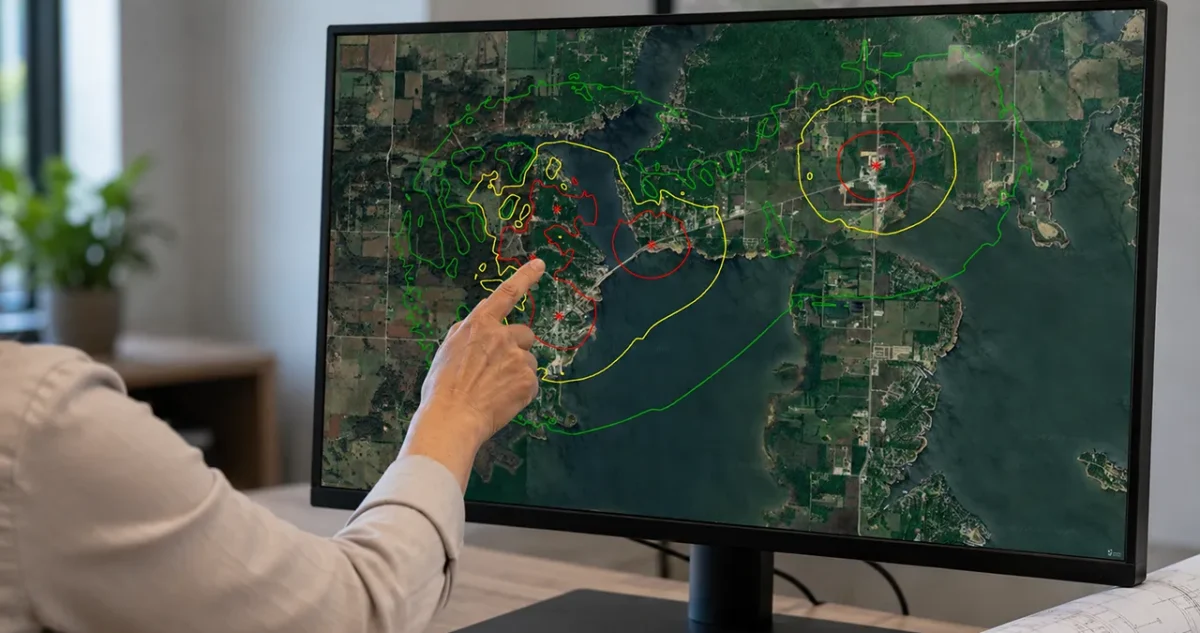
Warning system design follows four steps: a needs consultation, a coverage requirements review, an acoustic study, and system engineering and layout. The acoustic study is the step that decides whether people actually hear the alert, because it models terrain, buildings, and ambient noise instead of drawing circles on a map.
Planning a new system or replacing an aging one? OmniWarn provides no cost warning system design consultations.
Request ConsultationWhat actually happens during warning system design?
Warning system design is an engineering process, not a product selection. Before anyone quotes a siren, the design has to establish who needs to be warned, where those people are, what stands between them and the sound, and what the system should do automatically when a threat appears. Our warning system design and engineering process runs in four steps.
- Meet with you. The consultation establishes the hazards you are alerting for and the siren types under consideration, including tone and voice capable models.
- Identify your requirements. This is the coverage area itself: city blocks or open country, terrain, elevation change, and the pockets of population that are easiest to miss.
- Perform an acoustic study. Sound propagation software models how sirens will actually cover the area, how new units interact with any existing ones, and how tone and voice differ in reach.
- Engineer the layout. Our engineers build a siren layout designed to be heard by the people you want to protect across the coverage area, with the acoustic study behind it as the rationale.
Why does an acoustic study matter more than a coverage map?
That circle on a map approach assumes the ground is flat, empty, and silent. Almost no real coverage area is any of those things. Sound loses energy over distance, but it also reflects off buildings, bends around ridges, and disappears underneath highway and industrial noise.
Acoustic modeling accounts for terrain, structures, and ambient noise instead of assuming them away. That is the difference between a system that looks covered on paper and one that is audible where people actually live and work. It is also what keeps you from buying sirens you do not need, or from discovering a dead zone during a real warning.
What does a siren system design study account for on a real site?
Siren system design work is mostly the unglamorous business of accounting for what a map does not show. An acoustic study looks at each of the following.
- Terrain and elevation change, including ridges and valleys that block or channel sound
- Buildings and structures that reflect, absorb, and shadow the signal
- Ambient noise from highways, rail lines, and industrial operations
- How proposed sirens intermix with existing ones, so coverage layers rather than overlapping wastefully
- Whether tone or voice output suits each location, since the two carry differently across the same ground
For industrial sites this is a compliance question as much as a safety one. OSHA’s employee alarm standard requires the alarm to be perceivable above ambient noise levels for every employee in the affected portions of the workplace. On a plant floor that is a measurable bar, not a judgment call, which is exactly what an acoustic study is built to answer for emergency alert systems at industrial plants.
Not sure how your current coverage holds up against real terrain and ambient noise? That is what the study is for.
Request ConsultationHow do tone sirens and voice sirens change the design?
The two do different jobs, and most systems end up using both. A tone tells people something is wrong and to go find out what. A voice message tells them what is wrong and what to do about it. Which one goes where follows from the acoustic study rather than from preference.
| Output type | Where it fits | What to know |
|---|---|---|
| Tone only sirens | Wide area all hazard alerting | One recognizable signal meaning go inside and seek information. Outdoor warning sirens in this class suit alerting where the message is simply that something is wrong. |
| Voice capable sirens | Parks, sports complexes, and lakes | Giant voice sirens broadcast the specific hazard and the action to take. OmniWarn puts the Modulator series at up to one mile, though the coverage figure that matters for your site comes from the acoustic study. |
| Localized speakers | A single field, pool, or splash pad | The Federal Signal Informer 100 covers roughly the area of a football field, useful where a full siren would be overkill. |
Output level can also be tuned by hazard. The same hardware behind a tornado warning system can sound at full volume across the entire coverage area, then deliver a lightning warning system alert at reduced volume for the people immediately at risk. That keeps a community from being desensitized by alerts that do not concern them, which is a real failure mode in systems that treat every hazard identically.
Where do software and automation fit into the design?
Hardware placement is half the design. The other half is what triggers it and who can operate it. CommanderOne emergency notification software can activate sirens from National Weather Service polygons, send mass text alerts, and report system status from any browser or mobile device.
- Automatic activation from National Weather Service warning polygons, so the signal does not wait on somebody reaching a console
- Integration with FEMA’s Integrated Public Alert and Warning System, which reaches phones through Wireless Emergency Alerts and radios through NOAA Weather Radio
- Facility automation, such as unlocking community storm shelters on a tornado warning or shutting off splash pad water when lightning is detected nearby
- Local monitoring through weather stations and sensors, so decisions run on hyper local conditions instead of a regional forecast
Why should sirens never be the only layer in the plan?
Outdoor warning sirens are designed to warn people who are outdoors. They were never intended to wake someone in an insulated bedroom or to reach a worker inside a noisy building. A design that treats sirens as the whole warning plan has a gap built into it from the first day.
That is why a complete layout pairs outdoor coverage with indoor warning systems, mass messaging, and IPAWS pathways. It is also what the National Weather Service StormReady program asks of a community: more than one way to receive warnings, and more than one way to alert the public. FEMA’s IPAWS library covers the policy side for alerting authorities.
What should you have ready before a design consultation?
None of this is homework you need finished before calling. The more of it you can bring, though, the faster the design gets specific.
- A map or boundary of the area you need to cover, including outlying areas people assume are already covered
- What you are alerting for: tornado, flood, lightning, wildfire, hazardous material release, or some combination
- Any existing sirens, including model, age, and whether they still activate reliably. Our siren repair and maintenance crews can assess units you are unsure about
- How activation happens today, and who is authorized to do it
- Your funding path and timeline, since grant cycles often decide when a project can actually start
If you are earlier than that and still building the case internally, our guide to planning a tornado warning system covers the stage that comes before design. Once a design is approved, warning system installation and performance verification follow from the same engineered layout, which is why the two are worth keeping under one provider.
Bring your coverage area and your hazards. We will handle the acoustic study and the engineered layout.
Request ConsultationWhat does a warning system design consultation cost?
OmniWarn provides no cost consultations for warning system design. The initial meeting covers the hazards you are alerting for, the area you need to cover, and the siren types under consideration. The conversation is useful even if your project is still a line item in a future budget cycle.
How many sirens does a city or county need?
There is no per capita rule that answers this. The number falls out of the acoustic study rather than a formula. Two communities of the same population can need very different siren counts, because one sits in open country and the other is split by a ridge that stops sound cold.
Can new sirens work alongside our existing ones?
Usually yes, and the design should assume it. Part of the acoustic study is modeling how proposed sirens intermix with units you already own, so new equipment fills genuine gaps instead of doubling coverage you already have. Older sirens are evaluated for condition and for whether their activation method still fits.
Does an outdoor siren system satisfy OSHA requirements for a plant?
Not on its own. The employee alarm standard requires the signal to be perceivable above ambient noise for everyone in the affected area, which on a plant floor usually means indoor notification alongside outdoor coverage. An acoustic study is what turns that requirement into a measurable, documented design rather than an assumption.
How does the design account for people indoors or asleep?
It does not rely on the sirens to reach them. Outdoor warning sirens warn people who are outside, so the design layers indoor notification, mass text messaging, and IPAWS pathways that reach phones and weather radios. Treating sirens as one layer of several is a design decision made at the start.